
Tank Measurement Calculator
Measure a tank with a tape and a dipstick, then enter the shape, dimensions and liquid depth to see how many gallons or litres are inside, how full it is and how much space is left. Works for fuel oil, water, diesel and chemical tanks, and builds a printable dip chart.
- Free to use
- No sign-up
- Runs in your browser
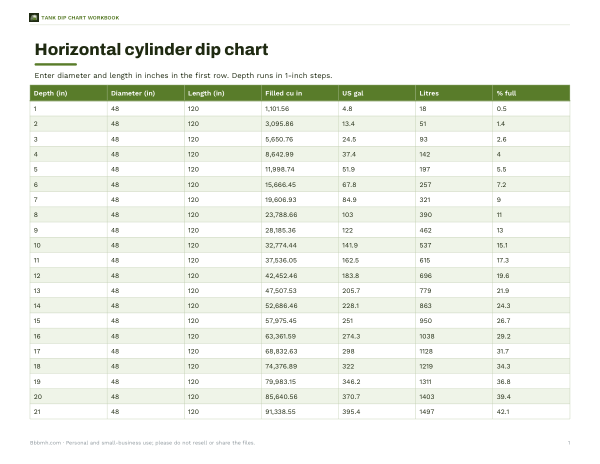
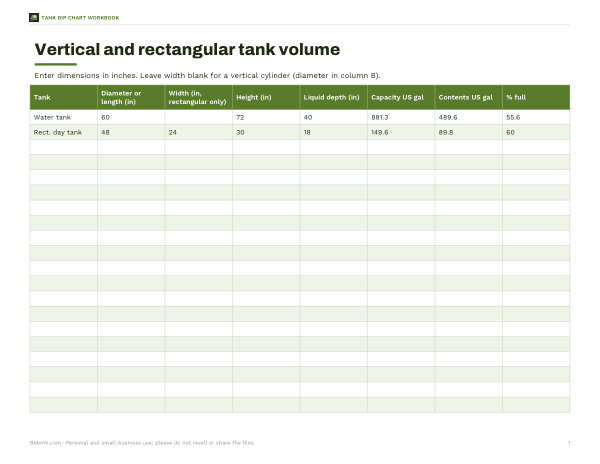
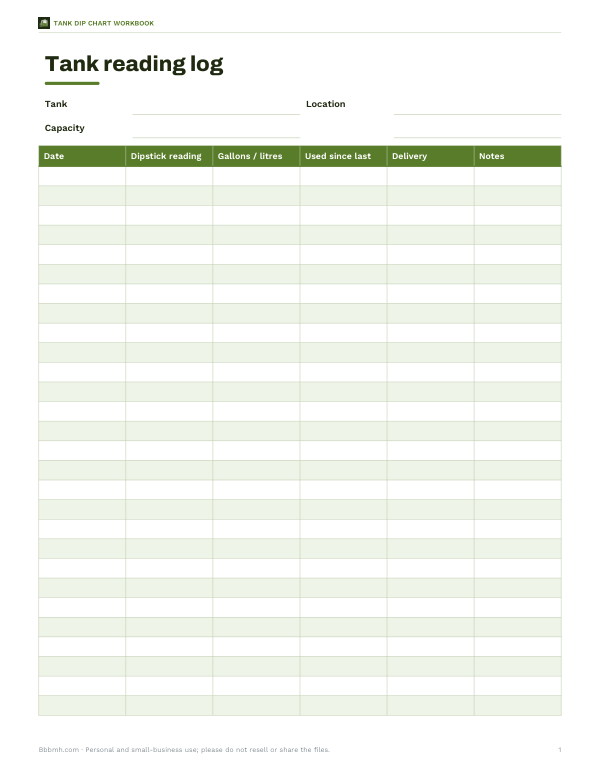
Tank volume from dimensions and depth
Tank Dip Chart Workbook
Excel dip chart generator for horizontal, vertical and rectangular tanks with gallon and litre tables, plus a tank reading log and delivery planner.
- Horizontal cylinder dip chart (XLSX)
- Vertical & rectangular tanks (XLSX)
- Tank reading log (PDF, DOCX, XLSX)
- Delivery planner (PDF, DOCX)
Formats: XLSX, PDF, DOCX. Instant download after payment (link valid 72 hours, up to 5 downloads). AI-assisted: the templates were drafted with AI help and reviewed and laid out before publishing.
$5.00 USD, one-time 4 files · about $1.25 each
- Instant download
- 7-day refund
- Secure checkout by Stripe
7-day money-back guarantee. Full refund within 7 days of purchase, even after you download.
Free sample: Fuel Delivery Planner (PDF, 52 KB)
Full refund within 7 days — see the refund policy and license.
Free printables
Single sheets you can print right now, no sign-up. The full pack adds every sheet in one download plus the editable files.
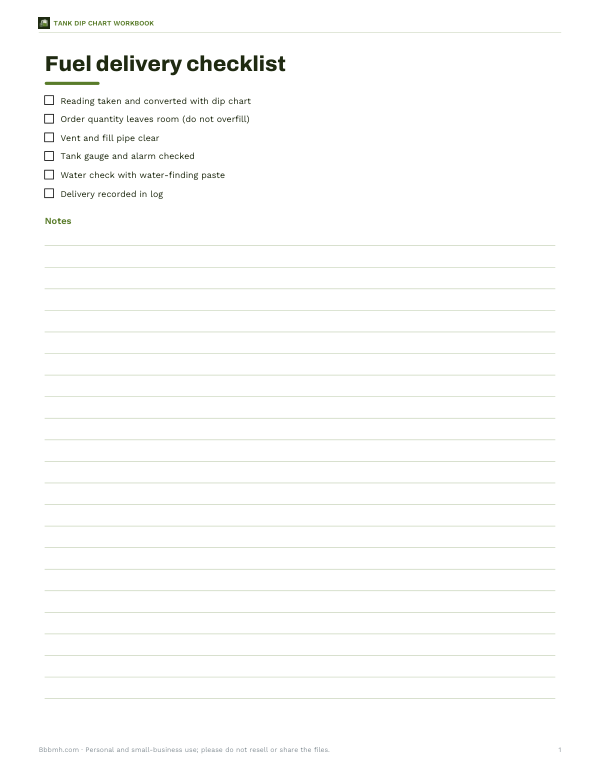 Printable Fuel Delivery Checklist
How to measure a tank
- Identify the shape: a cylinder lying on its side, a standing cylinder, a capsule with rounded ends, a standing oval (obround) tank, or a box.
- Measure outside dimensions with a tape, then subtract the wall thickness twice if it is significant (steel tanks are usually a few millimetres; plastic and concrete tanks can be thicker).
- For a horizontal cylinder, measure the diameter (or measure the circumference and divide by π) and the length of the straight section.
- Measure liquid depth with a clean dipstick lowered straight down at the centre of the tank, then read the wet line.
- Enter the numbers and read the volume. Build a dip chart to keep by the tank.
Measuring the circumference is often easier and more accurate than measuring diameter across a large tank: diameter = circumference ÷ 3.1416.
The formulas
| Shape | Total volume | Filled volume at depth h |
|---|---|---|
| Vertical cylinder | π r² × height | π r² × h |
| Horizontal cylinder | π r² × length | length × [r² cos⁻¹((r − h)/r) − (r − h)√(2rh − h²)] |
| Rectangular | length × width × height | length × width × h |
| Horizontal capsule | cylinder part + sphere (π r² L + 4/3 π r³) | cylinder segment + spherical cap πh²(3r − h)/3 |
| Standing oval (obround) | cross-section area × length | semicircle segments at top and bottom plus rectangle in between |
The horizontal cylinder formula calculates the area of a circular segment — the part of the circle below the liquid line — and multiplies it by the tank length. Because the tank is widest in the middle, each inch of depth holds more liquid near the centre than near the bottom or top. That is why a half-depth reading means half full, but a quarter-depth reading means much less than a quarter full.
Unit conversions
| From | To | Multiply by |
|---|---|---|
| Cubic inches | US gallons | ÷ 231 |
| Cubic feet | US gallons | × 7.48052 |
| Cubic metres | Litres | × 1,000 |
| Cubic metres | US gallons | × 264.172 |
| US gallons | Litres | × 3.78541 |
| Imperial gallons | Litres | × 4.54609 |
Worked example: horizontal cylinder
A steel tank lying on its side is 48 inches in diameter and 120 inches long. Its total capacity is π × 24² × 120 = 217,147 cubic inches, which is 940 US gallons (3,558 litres). With a dipstick reading of 20 inches, the segment formula gives about 371 US gallons (1,403 litres) — 39% full — even though the depth is 42% of the diameter. At 24 inches (half the diameter) the tank holds exactly half, 470 gallons.
Home heating oil tanks
Many indoor heating oil tanks are standing oval (obround) tanks with flat sides and rounded top and bottom. A common nominal size is listed as 275 gallons, but usable capacity is lower because tanks are not filled to the top and the outlet sits above the bottom. The calculator’s oval mode treats the cross-section as a rectangle with a semicircle at the top and bottom. Tank makers publish dip charts for their models; use them where available, and use this calculator to check them or when the label is missing. Oil gauges on top of tanks are approximate; a dipstick reading converted with a chart is more precise.
Building and using a dip chart
A dip chart lists volume for every inch or centimetre of depth. Build one with the button above, print it and keep it with the tank so anyone can convert a reading quickly. For fuel tanks, record readings in a log to track usage and order deliveries before the tank runs low. Round down when ordering fuel — a delivery that overfills a tank causes spills.
Accuracy and safety
- Tanks that are tilted, dented or have domed ends will differ from the ideal shapes.
- Liquid expands with temperature; fuel volume at delivery is usually corrected to a reference temperature.
- Sludge and water at the bottom of fuel tanks take up space; a water-finding paste on the dipstick shows water.
- Never enter a tank or lean into its opening. Use a dipstick from outside, and follow safety guidance for fuels and chemicals.
- For legal or commercial measurement (custody transfer), use calibrated equipment and certified tank charts.
Measuring wall thickness and internal dimensions
Volume depends on the inside of the tank, so outside measurements slightly overstate it. For a steel tank with 6 mm walls, subtract 12 mm from the outside diameter; for a plastic water tank with 10 mm walls, subtract 20 mm. On a large tank the difference is small, but on a small tank it can be several percent. If you can see the wall thickness at a fill opening or inspection hatch, measure it there. Insulated or double-walled tanks can be much thicker; the inner tank dimensions are usually printed on the label or in the manufacturer’s documentation.
Worked example: vertical water tank
A cylindrical rainwater tank is 1.8 m in diameter and 2.0 m tall. Its capacity is π × 0.9² × 2.0 = 5.09 m³, or 5,089 litres. A depth reading of 1.1 m gives 2,799 litres, 55% full. Because a vertical cylinder has the same cross-section at every height, volume rises in a straight line with depth — each 10 cm adds about 254 litres.
Frequently asked questions
How do I calculate the volume of a horizontal tank?
Multiply the area of the liquid segment of the circle by the tank length; the calculator does this for any depth.
How many gallons are in a cubic foot?
About 7.48 US gallons.
Why is my half-full tank reading not half the depth?
For horizontal and oval tanks, the width changes with depth. Only at exactly half depth is a horizontal cylinder half full.
Can I use it for a 275-gallon oil tank?
Yes, choose the standing oval shape and enter your tank’s height, width and length.
Does it handle metric units?
Yes, enter centimetres or metres and read litres.
Is anything uploaded?
No, all calculations run in your browser.
How accurate is a dipstick reading?
Usually within a fraction of an inch if the stick is vertical and read carefully; readings near the bottom and top of horizontal tanks are the least precise.